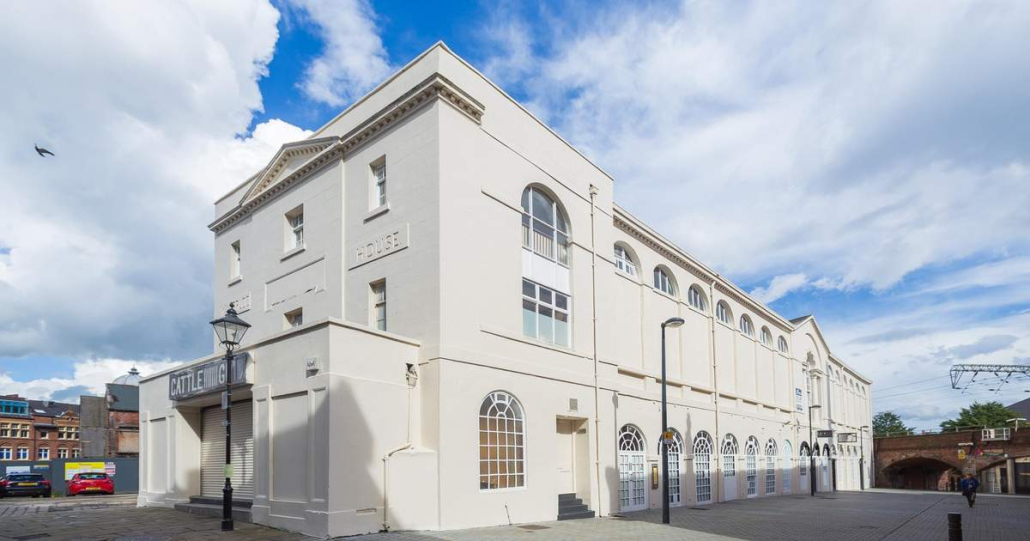
It now became evident that the new assembly rooms could be built over the north wing of the Cloth Hall, saving the cost both of purchasing another site and having to pay for expensive foundations. Work started in 1776, being completed in 1777 at a cost of £2,500. The architect is unknown, but most probably was William Johnson of Leeds, since he was agent to Lord Irwin, a supporter of the Hall, rebuilt the south wing of His Lordship’s house at Temple Newsam, and removed the cupola of the Second Hall to the gatehouses of the Third, where it still remains, in 1786.
In order to obtain the required width of 33 feet, the front wall of the new Assembly Rooms was supported on an open, arched collonade built beyond the south side of the north wing. Above this ran an elegant stone balustrade, then a series of blank arches topped by half-round windows, a large Venetian window being placed centrally beneath a broad, shallow pediment.
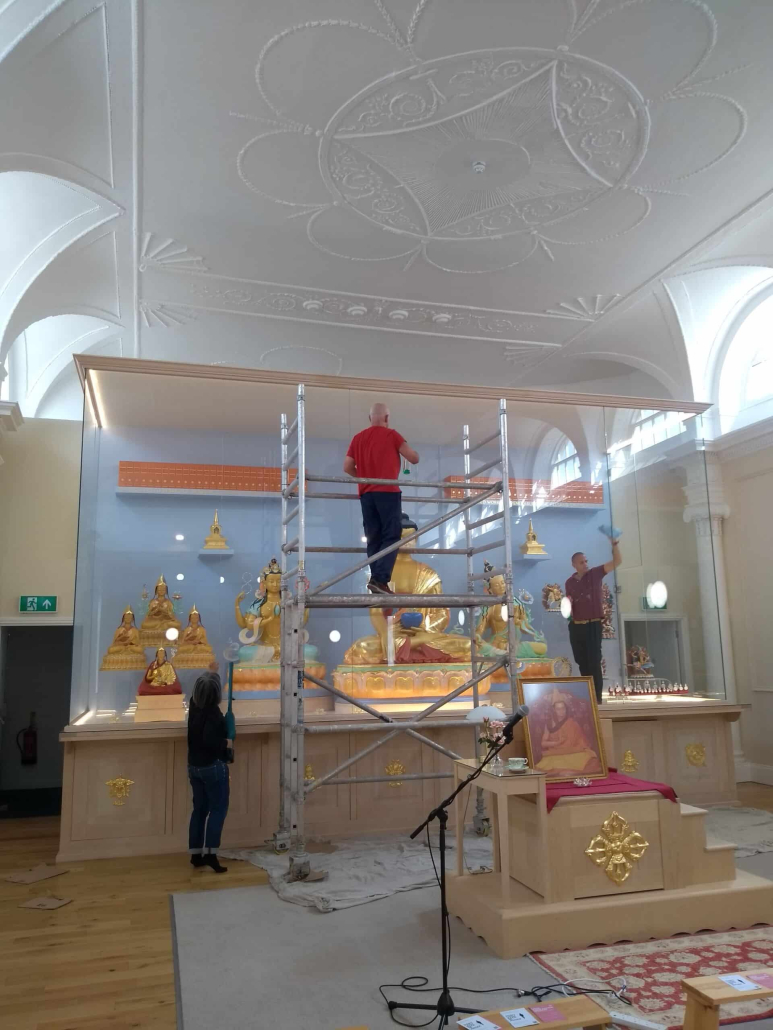
Since the rooms were to be used at completely different times to the cloth market, they had their own entrance stair at the north end of the west wing. From here a passage with a finely vaulted plaster ceiling led past a kitchen, then a large supper room, and on into the card room. Lit by the huge columned Venetian window and heated by a fireplace in its north wall, it was ideal for playing cards and gambling. The swags surrounding the central roundel of its ceiling took the form of rams heads, a reference to the town’s major source of wealth. Next came the ballroom, the most impressive room in the whole suite. Its stone-coloured walls were lined with freestanding columns topped by finely-detailed Ionic capitals and urns, all supporting a rich cornice. Above, 21 half-round windows were set into the deep vaults of the fine moulded plaster ceiling, iron hooks being fixed at the centre of each of the three roundels to support the large chandeliers needed for events held after dark. For the musicians, a gallery was provided in the western wall, to leave the floor clear for dancing.
The Assembly Rooms was opened on 9 June 1777, “by the most brilliant appearance of genteel company that were ever before assembled together here upon any occasion … The company in general were very agreeably surprised at the neatness and elegance of the different apartments, which allowed on all hands to be as complete and highly finished as any sest of rooms in the whole Kingdom.” Admission for one gentleman, or two ladies, cost half a guinea, suffiently high to exclude all but the wealthiest participants.
Regular assemblies directed by a master of ceremonies were held every two weeks from October through to June, alongside a range of concerts, balls and dinners. At the Yorkshire Archer’s Ball on 26 October 1780, for example:
“The company consisted of 200 ladies and gentlemen of the first rank and fashion in the country. The ladies appeared in white, with green ornaments and afforded the greatest display of taste and elegance. The ball was opened at 9pm by a minuet danced by the Earl Fitzwillian and the Countess of Mexborough … Country dances commenced at ten and the supper room was opened at 12 o’clock. It would be impossible to describe the decorations of the table … the propriety and brilliance with which they were ornamented reflect the highest credit on Mr Vickers of York. The effect of the festoons of coloured lamps was particularly pleasing. Dancing continued until 3am, soon after which the company began to retire, highly gratified with their evening’s amusement.”
From 1794 – 1808 the Assembly Rooms were also used by the Leeds Volunteer Corps, a local defence force raised when Napolean threatened to invate Britain. On 4 June 1794, the King’s birthday, they marched from the yard, round the town, and then back for a cold collation, toasts, songs, bonfires and a brilliant ball. More seriously, they assembled here on 6 April 1804, to hear the Articles of War before marching to York for three weeks training in preparation for offering their services to the War Office. Fortunately Admiral Nelson’s great victory at Trafalgar removed the threat of invasion, leading to their disbandment in 1808.
The courtyard was also used for spectacular events such as the ascent of Mr Lunardi’s balloon draped in Persian silks and gold lacing in 1786, Mr Green’s ‘stupendous Aerostatic Machine of blue, red and yellow silk’ in 1823, and Mr Graham’s ballroom in 1837. Other attractions included firework displays and Pablo Fanque’s Circus in 1858.
By this time the Assembly Rooms had fallen out of fashion and closed, only to re-open in the early 1880s to serve a completely different clientele, as the first Working Men’s Institute in Leeds. Here, for a penny a week, men were able to have the use of a washroom, canteen, games room, reading room and library, all supervised by Mrs Heathcote as housekeeper.